Page Contents:
Background
The saddle hunting industry predominantly consists of stick climbing enthusiasts who promotes two primary ropes, with definitions below, duplicated from the dictionary.
Tether: A short rope (typically 8-10ft) used to create an anchor point / TIP on the tree, providing a connection between the tree and the climber, typically via a carabiner on the bridge of the saddle. A tether is typically constructed from static climbing rope. One end is used to form an anchor on the tree trunk. The anchor point for a tether is typically installed within reach of the climber. A friction hitch or moveable device is installed on the line and connected to the bridge of the saddle using a carabiner. A stopper knot is on the other end of the rope. A tether holds the full weight of the climber and should be considered a life safety connection.
Safety Considerations
Please consider the following information. Related info:
A Running Loop is Unstable
A tether connects to the tree trunk using an “anchor”. The most common anchor used by saddle hunters with a tether is a “Running Loop” (not a Girth Hitch), creating an unstable anchor, which can droop, sag and fall when subjected to slack, movement and load cycles. JRB recommends a tether or lifeline which employs a more stable anchor.
Lifeline vs Tether
Instead of a tether, JRB recommends that climbers consider using a lifeline instead, specifically a rope that safely connects us to the tree at all times and provides a rappel path to safety on the ground. Think of a Lifeline as a “long tether”. See FAQ:
Design Considerations
Below are some considerations for a tether design:
Rope
There are recommendations for rope diameter vs weight on the rope page, as well as product recommendations. A tether is a life-safety component; do NOT skimp by using an old or unidentified rope with questionable age or quality.
Length
Some tethers are only 8 feet in length. JRB recommends a longer tether, so as to ensure that even on a large diameter tree, the tether is long enough to operate and provide enough spare rope at the bottom for emergency scenarios. For example, if a saddle hunter experienced a loss of footing, falling forward into the saddle, leg straps digging into the groin and is not able to self rescue, there must be a way to get weight from our feet onto the tether in order to adjust the saddle to alleviate the pressure and redistribute weight. JRB’s design uses 12′ of rope, creating a tether that is about 11′ long.
Anchor
The Anchor. There are many anchors for a rope in a tree. For a tether, JRB recommends the Allegheny Hitch:
Friction Device
JRB prefers a self tending friction hitch which can be released under the full weight of our body in an emergency situation. Many popular mechanical ascenders cannot be released under load and create a risk that the climber could become stuck on a tether in the event of an irrecoverable loss of footing. Consider the Compact JRB Ascender, Longhorn Agile, or Kraken with the Longhorn Tender. See the page for all the choices:
Stopper Knot
JRB prefers a (simple) double overhand knot.
Carabiners
Your saddle may already have a carabiner for connection to the tether. You may need a 2nd carabiner depending on the anchor used.
DIY Tether Design
Ape Canyon offers a kit for JRB’s Tether/Lineman’s Belt Design, which is explained in the video below. This is an amazing deal; the carabiners cost as much as the entire kit…your JRB15 coupon code applies as well!
If building without the kit, the materials needed are:
- 12′ of rope
- 6mm Cord:
- 64″ for a 9 mm rope
- 60″ for an 8 mm rope
- 2 carabiners
This video shows how to tie the Compact, Non-jamming JRB Ascender:
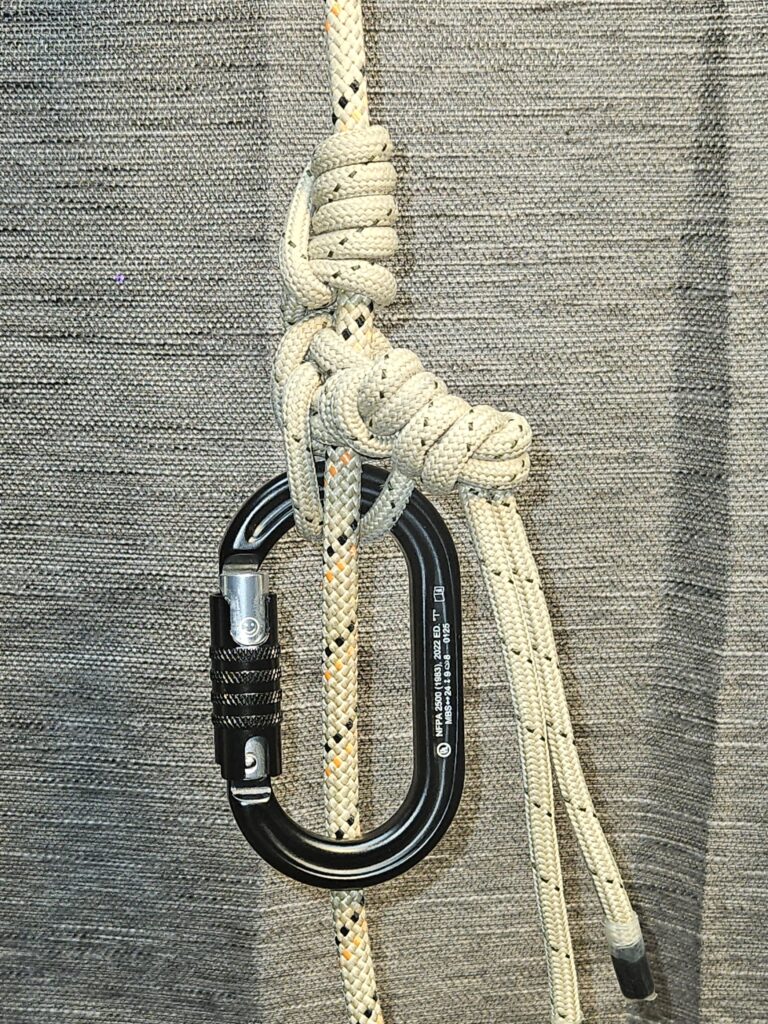
This photo shows the correct positioning of the carabiner around the rope for optimal tending.
Ape Canyon Products
See Ape Canyon’s Tether selection here, and use the JRB15 coupon code for 15% discount on items not already discounted: