Bottom line: JRB does not recommend Climbing Spikes(spurs) for Saddle Hunting.
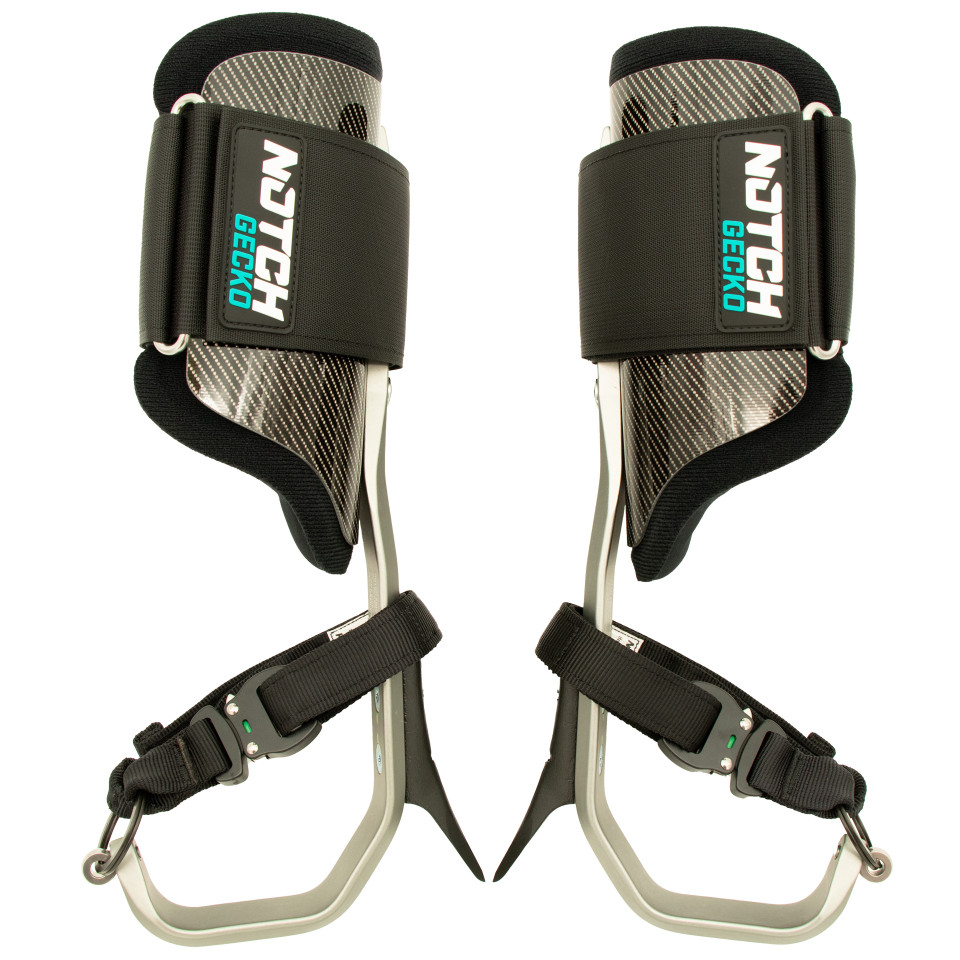
One of the most common questions asked by saddle hunters pertains to the use of Tree Climbing Spikes as a tree climbing method in a hunting situation. Climbing Spikes (also known as Gaffs, Hooks or Spurs) are devices worn on each leg/foot which are equipped with sharp spikes (positioned near the ankles) which are driven into the tree with a downward kick. Spikes are sold in 2 different varieties for either bark-less poles (used by a Lineman) or Trees (used both Arborists). Climbing spikes were traditionally used with a Lineman’s Belt (or Buckstrap, Lanyard or Flipline) which goes around the tree/pole. In modern day, it is recognized that these devices are inadequate due to the lack of a cinching connection to the tree.
Disadvantages
- Tree Damage: Spikes puncture the cambium layer of the tree (under the bark), causing damage to the tree and risk of disease, which can eventually kill the tree. For this reason, arborists are not supposed to use spikes when pruning trees. See article: TCIA Article.
- Legality. In most public hunting lands in the USA, climbing spikes are not legal for use. (Check with your local regulations.)
- Noise: In order to use spikes properly, they are supposed to be ‘kicked in hard’ which is NOT a quiet activity. Hunters generally try to be quiet and frequently don’t sink them in deeply enough, leading to “gaff outs”.
- Logistics: We don’t want to walk with them and so they need to be carried and put on at the tree. We also don’t want them to come in contact with our platform, and the logistics of taking them off when aloft and storing them is a hassle.
Dangers
Dangers: Climbing spikes been involved in countless accidents. Consider the hazards:
- Gaff outs. The primary risk is that they are prone to “gaffing out” (kicking out of the tree), causing the climber to lose balance, shift sideways, lose the spike other side, and fall, often grinding down the tree on the way. Recovery from a gaff out is NOT something that most are prepared for. Arborists are trained to pull up a lifeline with them when using gaffs such that they can execute an emergency rappel.
- Lineman’s Belt is inadequate. Professional utility pole workers do NOT use a Lineman’s belt when using gaffs. They use a “squeeze” device, which cinches, and are trained to recover from failures.
- Technique. As stated above, when used properly, with each step, spikes are driven into the tree with force, which is not a quiet activity. Because hunters strive to minimize noise, they may not exert adequate force in kicking them in, minimizing the puncture depth, and increasing risk of a “gaff-out”.
- Tree details. Stability/bite is reduced in trees with scaly bark and wet conditions.
Legitimate Uses
- By a trained lineman on a bark-less, wood pole, and only if used in conjunction with a “squeeze device” (not a lineman’s belt).
- By an arborist in tree removals, but not for use in pruning. See article: TCIA Article. Also, the climber should be tied into the tree ensuring that if a gaff-out occurred, the climber can recover.
- By trained professionals in emergency and rescue situations.
Bottom Line: JRB does not recommend the use of Climbing Spikes for Saddle Hunters. Remember: It doesn’t matter how we CAN climb a tree. It matters that we can do so reliably, repeatedly, and in adverse conditions with negligible risk of an injury or fall.
Products
For legitimate applications, see the selection at Rock-N-Arbor and use the JRB15 Coupon Code: Rock-N-Arbor – Climbing Spurs